RAD-Lager
Stolberg
Reich Labor and Military Training Camp in Mausbach
Reich Labor and Military Training Camp
The Reich Labor Service (RAD) was an organization in the National Socialist German Reich. The Reich Labor Service Act was enacted on June 26, 1935. It stated, among other things: “All young Germans of both sexes are obligated to serve their people in the Reich Labor Service” and “The Führer and Reich Chancellor determines the number of conscripts to be called up annually and sets the duration of service.”
Compulsory labor service had already existed during World War I under the Auxiliary Service Act as part of the Hindenburg Program. This law provided for a general labor obligation for men between the ages of 17 and 60 in the war economy. The labor service in its later form was introduced in 1931–32, particularly for all young people, as the “Voluntary Labor Service” in connection with the Great Depression of the 1920s. As the Nazi regime took hold after 1933, the Reich government, through the Reich Labor Service Act of June 26, 1935, compelled all young adults between the ages of 18 and 25 to perform “public service” work. This “service” was initially limited to half a year. According to the law, the goal of the Reich Labor Service (RAD) was “to educate German youth in the spirit of National Socialism toward a national community and a true understanding of work, above all toward due respect for manual labor.” Just as important as this ideological goal were the reduction of unemployment figures and rearmament.
German youth were to be made “fit for war.” To this end, they worked on reclaiming land, building roads, farming, and constructing military (defense) fortifications such as the “Westwall.” The “working men” and “working women” were housed in separate RAD camps.
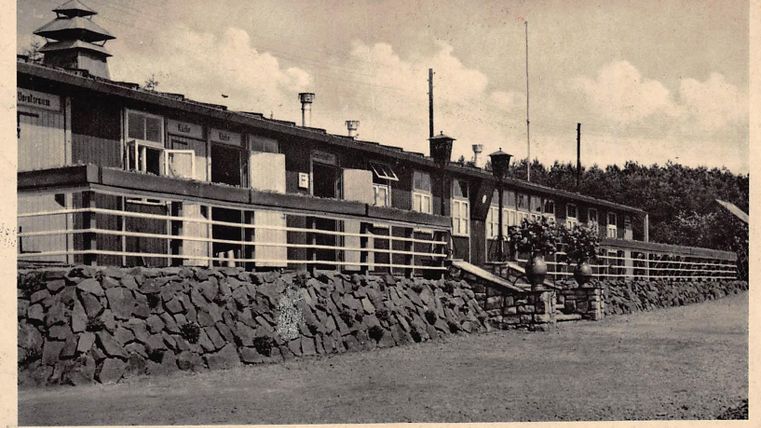
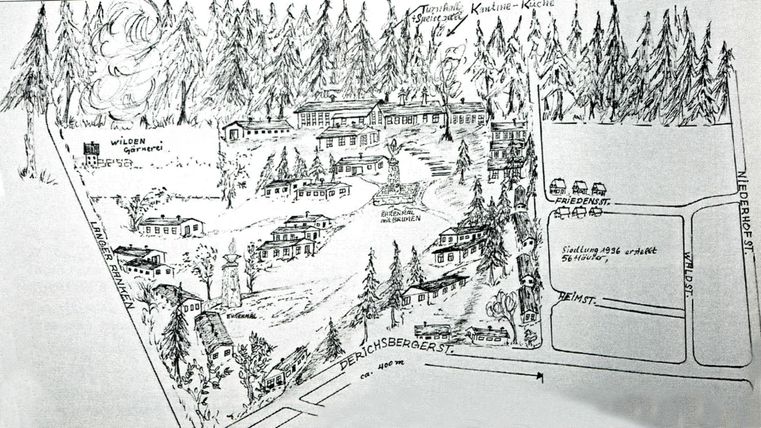
The Mausbach Reich Labor Service camp was established in 1938. By 1942, it had already been vacant for some time.
Text sources: Wikipedia/Reich Labor Service; Federal Archives
Transit camp for Jewish transports
The camp was established in 1938 and used by the Reich Labor Service until 1942. It subsequently took on tragic significance as a transit camp in the Nazis’ extermination strategy, for in June 1942, more than 300 Jewish people—mostly from retirement homes in Cologne—were crammed together here for several days before their transport to the death camps.
Residents of Mausbach recount that the elderly arrived by streetcar at the church at dusk and from there had to make the journey to the camp on foot in a pitiful procession, carrying their heavy suitcases. Young men who wanted to help carry the luggage were stopped and sent away by the head of the Mausbach women’s association.
Sensing their fate, Toni and Richard Löwendahl took their own lives with Veronal on June 14, one day before their deportation to the Theresienstadt extermination camp. Richard and Toni Löwendahl were 75 and 59 years old. An official report on the deportation of people from the Mausbach camp via the Stolberg main train station requires no comment:
“The transport of 340 Jews from the Mausbach camp to the streetcar … proceeded without hindrance. By 8:40 a.m., the people had been loaded into 12 streetcar cars and were taken to the main station in Stolberg Rhld. The special train from Herzogenrath did not arrive there until 12:10 p.m. Loading the Jews into freight cars was only possible with the assistance of all police officers present, as the elderly were unable to climb into the high cars. Each car accommodated 45 people, including their luggage. The loading was carried out under the orders and supervision of officers from the Stapo [State Police]. At 12:30 p.m., the train was able to depart for Cologne. At the Mausbach camp the previous night, two Jews had taken their own lives by poisoning themselves with Veronal. The Stapo […] handed me 20 RM to distribute among the officers on duty. The amount was divided among the 15 men on duty.
After Hitler ordered the establishment of so-called “Hitler Youth military training camps” in March 1942, the camp was used as such by the SS beginning in August 1942. The goal of the indoctrination carried out there was also to psychologically prepare the recruits for an unconditional willingness to die on the battlefronts.
Text sources: Dr. Franz-Josef Ingermann, “Inhumane Conditions in the Camp,” in: Stolberger Nachrichten, Aug. 12, 1988; Group Z, “Moved to Auschwitz” (1995), pp. 14–15; Manfred Bierganz, “The Story of the Suffering of the Jews in Stolberg During the Nazi Era” (1989); Martin Rüther, “I Want Power,” Federal Agency for Civic Education (2017), p. 180
This route was developed as part of the LEADER-funded project “Quality Initiative for Hiking in Roetgen and Stolberg” with support from the European Union (EAFRD) and the state of North Rhine-Westphalia.
Impressions

Contact
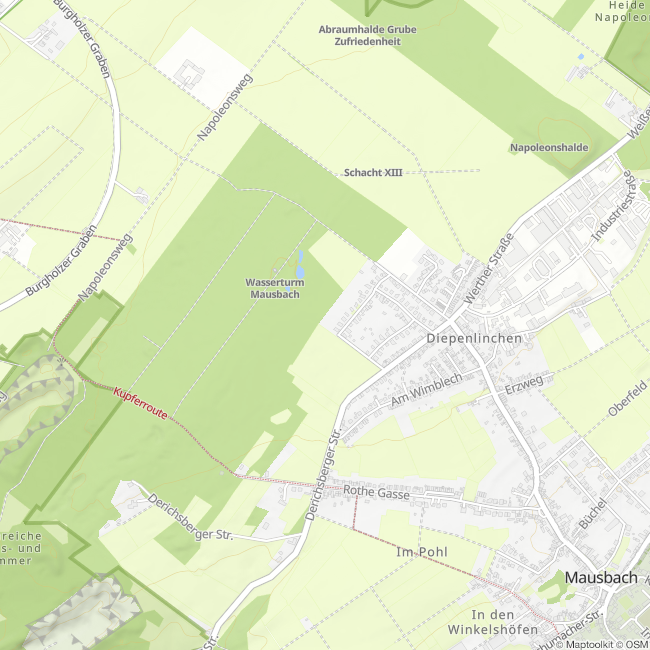
Panoramarundweg Mausbach
52224 Stolberg