Pferdebahn
Stolberg
Transport of the material to be processed
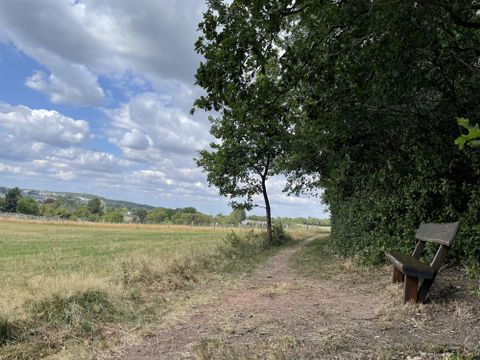
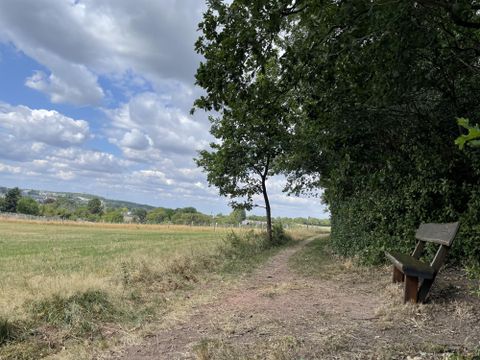
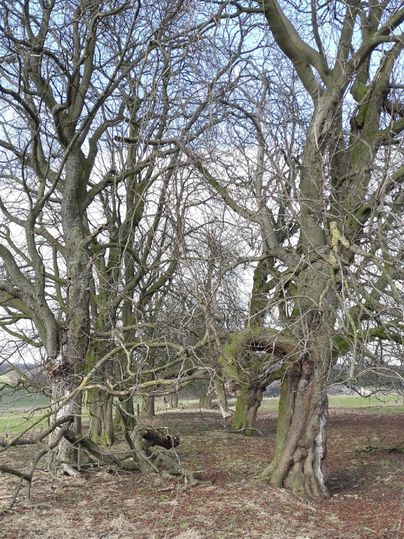
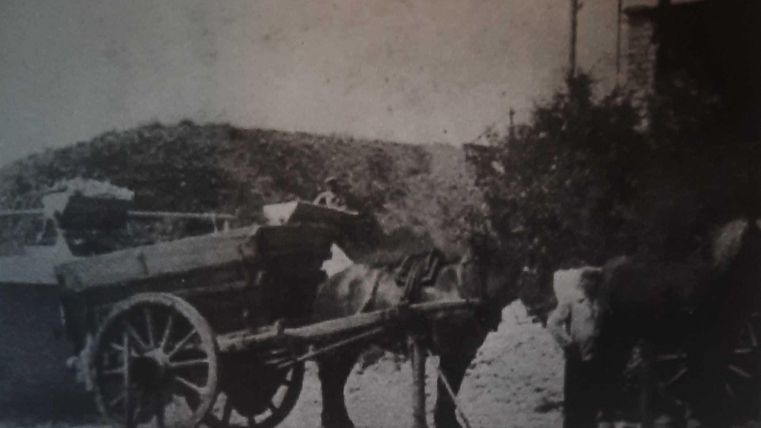
Between the chestnut trees visible in the background, you can still see the ballast of the former horse-drawn railway. Just as here, the first railroads in other locations were pulled by horses on iron-shod wooden planks.
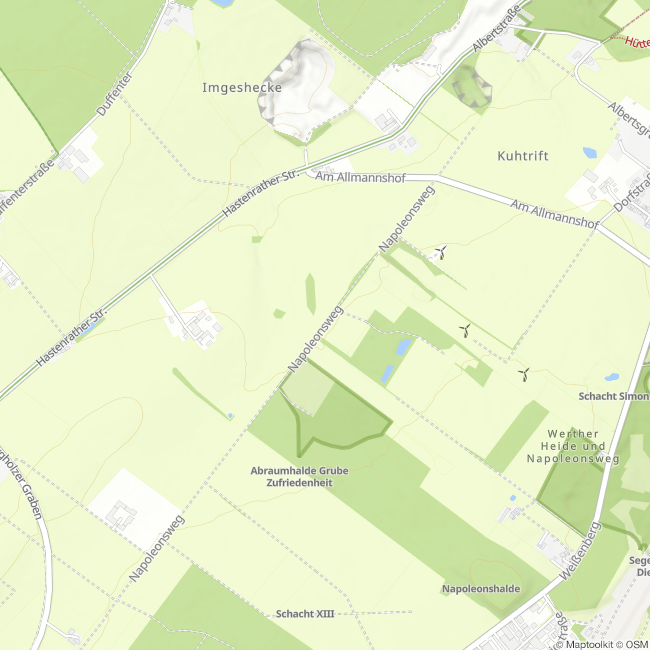
The horse-drawn tram connected the “Zufriedenheit” mining shafts with the processing plant at the “Albertsgrube.” It was here—and not, as originally planned, on the “Zufriedenheit” site—that the ore processing facilities were installed. At the site of this station, the original route branches off from Napoleonsweg, which at that time did not yet run continuously all the way to the “Albertsgrube” processing plant, but instead led directly from here into what is now Hastenrather Straße.
The Meyer family operated this horse-drawn tram—as well as another horse-drawn tram—between what is now the Hastenrather quarry and the Concordia Hütte (Eschweiler). To this end, Robert Meyer had over 40 horses in his haulage operation in 1911.
On February 27, 1851, a permit was granted for a lead and zinc ore processing plant at the Henriette shaft in the Zufriedenheit mining field. However, the approved ore processing plant was not built at the Henriette shaft as requested, but rather below the machine shaft of the Albertsgrube (see the “Albertsgrube” sign).
The reason for this is believed to be the dewatering tunnel (60 m at the floor level), which was never fully completed; its planned total length was 500 Ruthen (1,883 m), but its completion was presumably abandoned for economic reasons.
Accordingly, a horse-drawn transport railway had to be constructed to process the ore extracted from the shafts of the Zufriedenheit concession.
The railway branching off here was replaced by a new railway line following approval of the application on January 3, 1906. This new line ran along the fully developed Napoleonsweg. As a result, the gradient to be overcome was reduced.
Nevertheless, operating the new railway was not exactly easy, as derailments occurred frequently. The old railway was therefore abandoned and fell into disrepair.
(Text: Jens Mieckley)
This route was developed as part of the LEADER-funded project “Quality Initiative for Hiking in Roetgen and Stolberg” with support from the European Union (EAFRD) and the State of North Rhine-Westphalia.
Impressions

Contact
Montanhistorischer Rundweg
52224 Stolberg