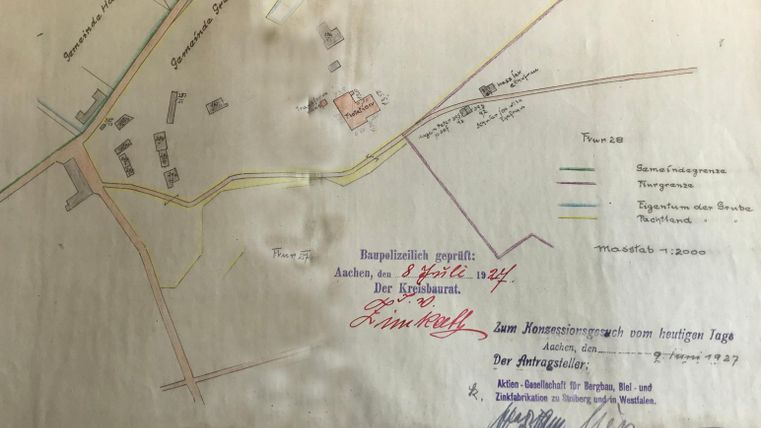
Flotationsverfahren 1927
Stolberg
Activities Following the Closure of Diepenlinchen
Ore Processing and Flotation in the Stolberg Mining District
For many centuries, a process known as density sorting was used to separate usable ores from waste rock. This method took advantage of the differences in specific gravity between the ore and the waste rock.
The ore-bearing rock extracted from the mines was first crushed using stamp mills, grinding mills, or rock mills. The target particle size depended largely on how finely the ore was distributed within the host rock. The individual particles had to differ significantly in their ore content and waste rock composition to make separation by density sorting effective.
The actual separation took place under a gentle stream of water on inclined tables that were mechanically set into vibration. In this way, the grains settled according to their specific gravity—a process also known as shaking or jigging.
The galenaore, which was the primary ore mined in Stolberg, was a polymetallic ore containing zinc blende, galena, and pyrite (or marcasite). For this reason, it was particularly important to separate the sulfides not only from the waste rock but also from one another.
Flotation Processes in the 1920s
In the 1920s, ore processing underwent significant further development. The flotation process (also known as flotation processing) took advantage of the different surface properties of the minerals. This required the ore to be finely crushed using rock mills.
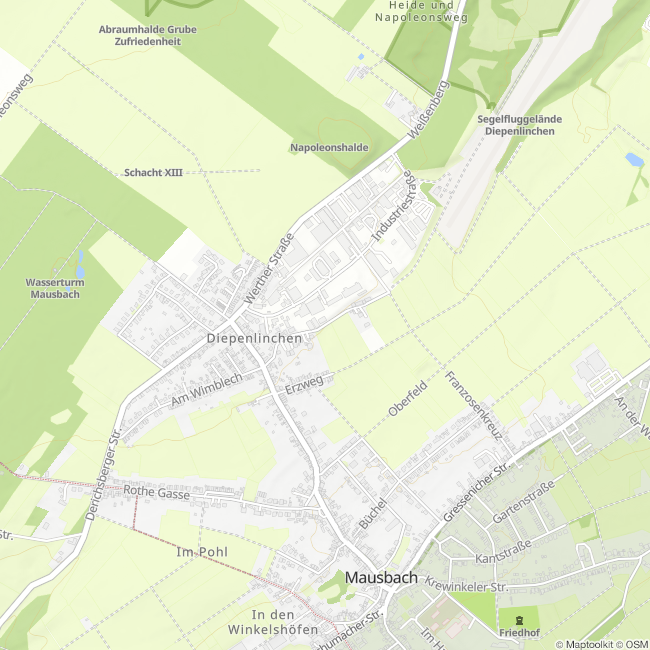
After the closure of the Diepenlinchen mine, the operating company, the Society for Mining and Zinc Production in Stolberg and Westphalia (Stolberger Zink), remained active throughout Europe. In 1927–28, it built a flotation plant on the Weißenberg with a capacity of 5 metric tons per hour.
Initially, the plant was used to reprocess old pond and tailings slurry, as this material was suitable for flotation without further crushing. By 1933, over 4,000 metric tons of usable ore concentrate had been recovered in this manner.
In line with the self-sufficiency efforts of the 1930s, coarse material from the tailings pile was increasingly crushed and processed from 1933 to 1942. The sandy residues produced in this process were deposited on the tailings pile at Weißenberg.
This route was developed as part of the LEADER-funded project “Quality Initiative for Hiking in Roetgen and Stolberg” with support from the European Union (EAFRD) and the state of North Rhine-Westphalia.
Impressions
Contact
Panoramarundweg Mausbach
52224 Stolberg